


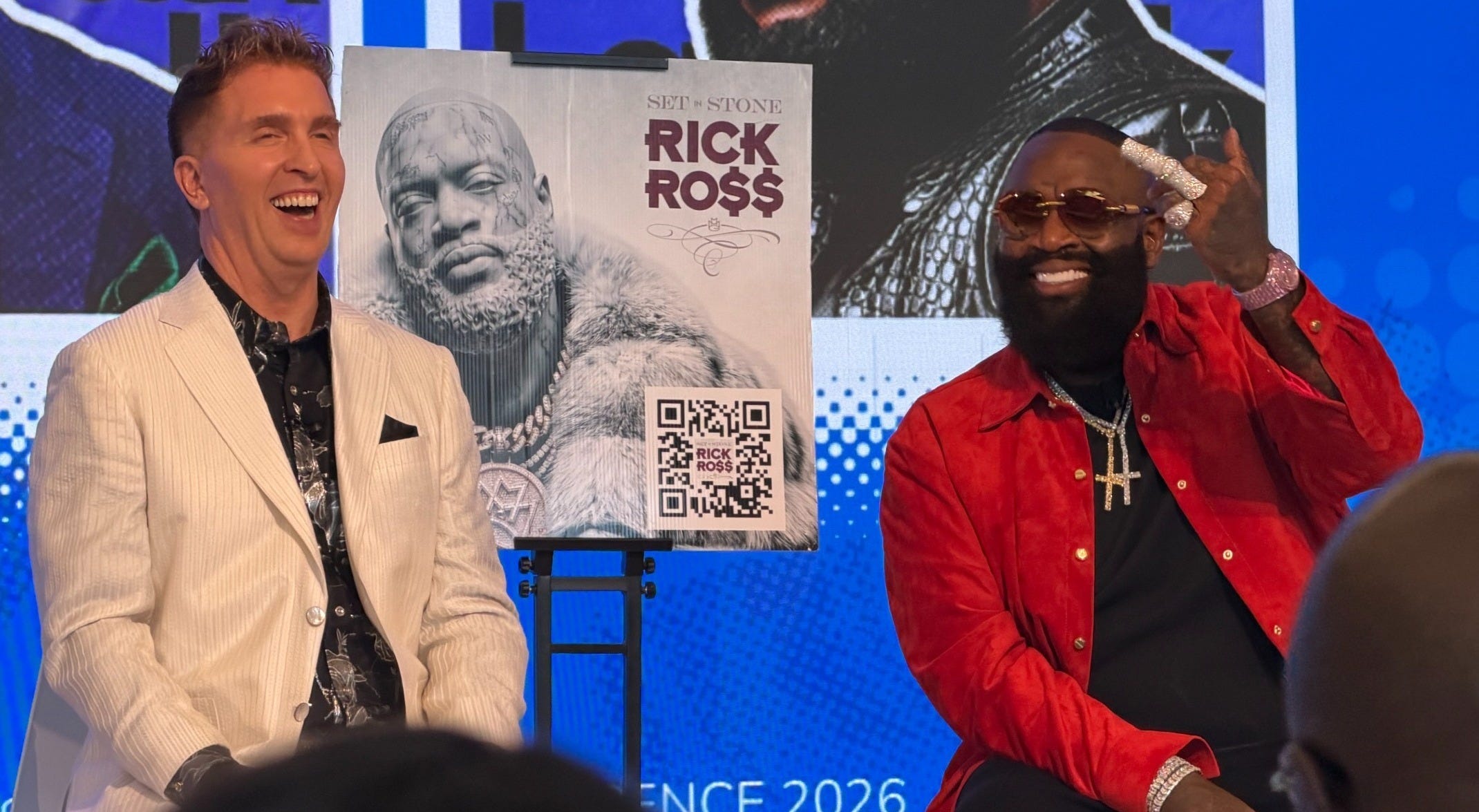
“Rick Ross, baby!” David Coulter declared from the stage, invoking the rap mogul and entrepreneur. “He’s coming down, and let me tell you something: He is ready to give the middle finger to the banks!”
It was the kickoff of SmartCredit’s annual conference, and Coulter, the founder and CEO of its parent company, ConsumerDirect, was setting the tone. He described the gathering as “a very social media conference,” offering one piece of advice: “Post, post, and when you’re exhausted, post again.” He rattled off their recent badges of mainstream respectability: an L.A. Times “Founder of the Year” honor for himself, nine national workplace awards for his company, and, most satisfying of all, a financial-services award he said Experian had won the year before. “In your face, Experian!” he crowed. Overhead, bright blue banners spelled out the conference’s theme in playful looping script: “MAKE MORE MONEY.”
Coulter returned to the message again and again. “Sure, we like to make money,” he told the room. “The theme of this SmartCredit conference is make more money, right?” But it was important, he assured the sold-out crowd, not to forget their higher purpose as credit repair professionals. “Remember, when you are making more money, you’re helping people at the same time,” he said somberly. “That’s a good feeling. That makes me happy to be the CEO of this company.”
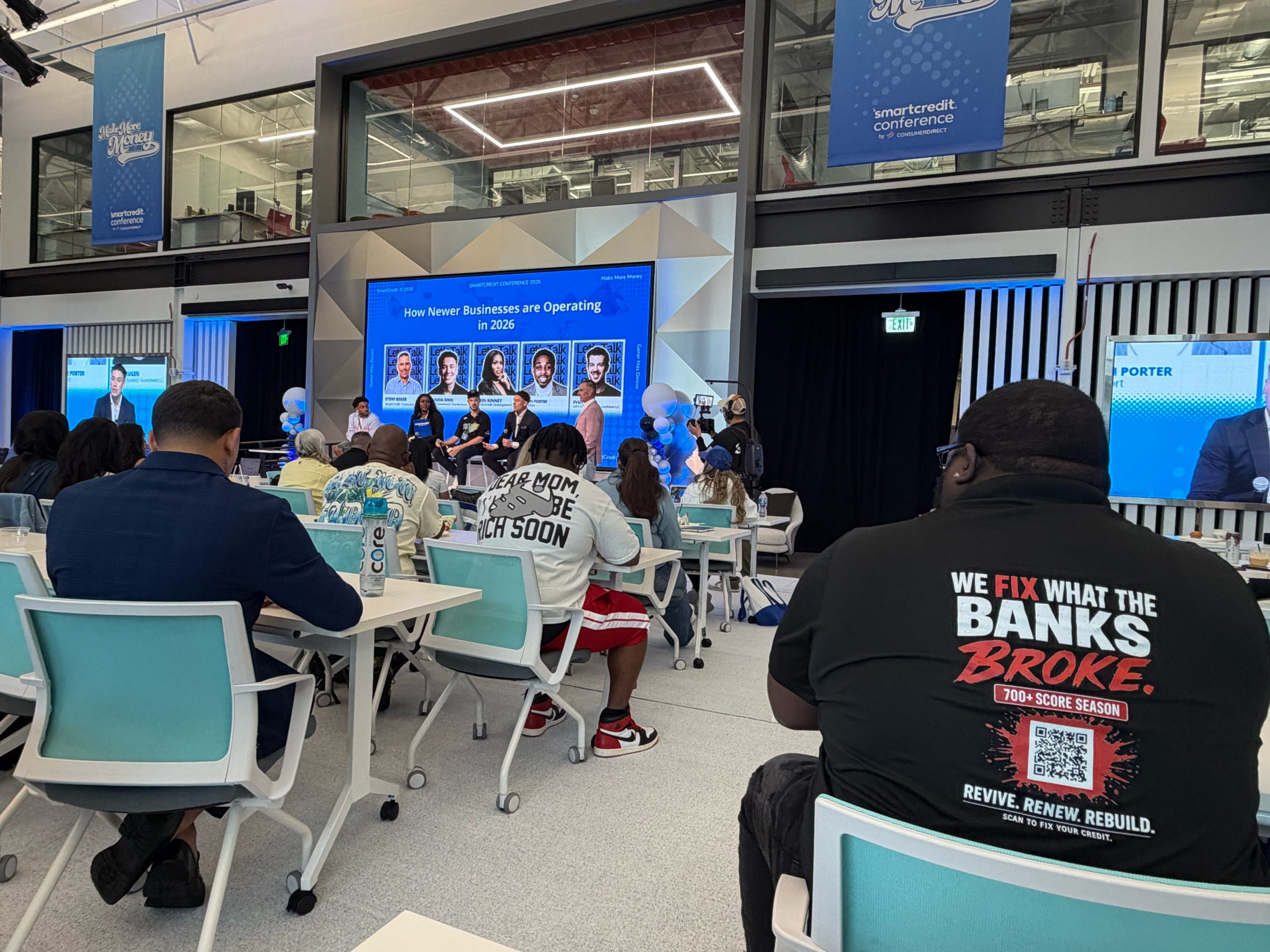
Credit repair, the business of improving a consumer’s credit score through disputes and building positive credit history, is experiencing a golden age in 2026. The 250-or-so conferencegoers reflected the industry’s new ecosystem: social media influencers, hustle-and-grind internet entrepreneurs, and specialists who had turned dispute letters and credit-bureau lawsuits into high-volume service businesses. Many of them had a nice arrangement with ConsumerDirect. They required their clients to subscribe to SmartCredit to monitor their credit reports and scores. ConsumerDirect then paid these specialists a cut as long as those clients stayed subscribed, providing them with a life-giving stream of recurring income. The stream was running high. ConsumerDirect’s net revenue reached $128.6 million in 2025, up 38 percent, while its marketing and referral-share costs totaled $78.4 million.
For the credit bureaus, the credit repair industry’s success has meant an overwhelming flood of disputes. In 2019, the CFPB received just over 150,000 credit-reporting complaints. In 2025, it received 5.8 million — a surge it attributed in part to credit-repair’s AI and social-media renaissance. And yes, much of it is going directly in Experian’s face: the target of Coulter’s taunt reported an elevenfold jump in monthly CFPB complaints from January 2022 to May 2025.
All of this spells trouble for lenders’ fraud teams. Fraudsters can tap the same credit-repair services as honest customers to scrub away evidence of bust-outs and other forms of first-party fraud. Automation and outsourcing give their claims reach and persistence; the division of labor diffuses responsibility for checking their truth, and the volume makes false disputes harder to distinguish from legitimate ones. In April, the American Financial Services Association warned of an “immense increase in credit washing” – using false disputes or identity-theft claims to remove accurate negative information from credit reports. Its president and CEO, Celia Winslow, told Congress that social-media influencers, fraudsters, and AI-driven scam platforms were “distorting credit scores at scale.”
The fairy godmothers of credit repair
Credit-repair companies cast themselves as consumer champions, helping borrowers assert their rights under the Fair Credit Reporting Act to dispute inaccurate information and require credit bureaus to investigate and correct or remove information they cannot verify. But describing credit repair as a humble business of error correction is a bit like saying Cinderella’s fairy godmother showed up to help her get dressed. The industry promises transformation: a loan for a house, financing for a car, admission to a world previously out of reach. Outside in the conference parking lot, one credit specialist had spelled out the promise on his custom Tesla Cybertruck: “We don’t just fix credit...we fix your future.” But not all credit repair customers have Cinderella stories. Borrowers looking to hide accurate defaults seek the same bibbidi-bobbidi-boo. So do fraudsters.

Regulators have spent decades trying to stop credit-repair companies from promising a fresh start to everyone — be they true victims, truant borrowers, or con artists between jobs. Laws like the 1996 Credit Repair Organizations Act bar companies from making deceptive promises, coaching consumers to make false claims to lenders or credit bureaus, or collecting fees before completing the promised work.
Companies like ConsumerDirect have spent those same years playing close to those lines, and occasionally drawing a regulator’s whistle for crossing them. In 2006, California’s attorney general sued Coulter and his company, then operating as MyPerfectCredit, alleging that it frequently challenged every negative item on their credit reports, billing up to $6.95 per dispute. (The company had told customers it was exempt from state credit-repair laws; it and Coulter settled without admitting liability, agreeing to $150,000 in civil penalties plus restitution for customers who had complained). ConsumerDirect launched SmartCredit in 2009 and shifted toward partner distribution in 2017. The company says customers now pay for scores and monitoring — not its dispute tools, which are free — with part of the customer’s monitoring subscription fee coming back to the credit-repair firm as a referral commission.
“You and us together, we form a phenomenal team,” Coulter told the room.
“Put the liability on Bruce”
At ConsumerDirect’s headquarters, that togetherness came with a disclaimer. Before each talk, speakers were required to display a boilerplate slide for twenty seconds, stating that ConsumerDirect did not “review, approve, authorize, endorse” their businesses or claims. Then they could begin addressing the audience ConsumerDirect had assembled in its own lobby.
“Okay, cool. Disclaimer! Let’s pray over this,” said Evan Rugen, founder of Lets Get Funded, as he waited for the 20 seconds to pass. “All right, I think we’re good.”


For a conference nominally about credit repair, much of the talk about the work itself — disputing debts, adding credit accounts — concerned how to get someone else to do it.
“I don’t update clients. I don’t onboard. I don’t send out disputes. I don’t do letters,” said Nainoa Shin, the conference emcee, who runs the credit-repair business Trust the Process and has 280,000 followers on Instagram. He told conferencegoers he collects $40,000 a month from SmartCredit subscriptions alone. Elijah Porter, owner of CredPort, speaking on a panel titled “How Newer Businesses Are Operating in 2026,” said disputes were the first task he’d outsourced; he’d recruited his eleven Philippines-based virtual assistants through OnlineJobs.ph. Evert Calderon of Mesa Group Consulting, in a talk called “Cloning the CEO w/ AI” said he used AI-generated dispute letters, which kept costs at “about three cents for each letter,” before postage.
But what about the risks of outsourcing? One audience member shared a story about a virtual assistant he’d hired in Pakistan who had falsely disputed his own car loan as identity theft.
“Put the liability on Bruce, right?” smiled Shin, gesturing toward Bruce Politano, whose company, Credit Repair Junkies, offers outsourced dispute work alongside software and coaching (“1,700+ COMPANIES SERVED,” its website boasts). Politano smiled back from the front row.
In practice, credit-repair paperwork typically puts the liability on consumers themselves, according to three credit-repair specialists interviewed for this story. Customers sign contracts attesting that they believe the records being disputed are inaccurate; the firms then prepare and send dispute letters as if they came directly from those customers. By the time a dispute reached a bureau, the chain of businesses and software behind it would be invisible, leaving only the customer’s signature to vouch for its truth.
Coming to a feed near you
Their work might be hidden from bureaus and lenders, but their faces should be unmissable on social media, the conference speakers urged. Israel Cordova, a credit-repair entrepreneur with 419,000 followers on TikTok, told specialists to think like TV programmers and broadcast a mix of commercials, news, and entertainment to their followers. Sharif Ceasar of Content Cartel, with 2 million followers on Instagram,,prescribed the proportions: 50 percent education, 20 percent results and testimonials, 15 percent origin story, and 15 percent identity and worldview. They should also “niche down,” said Christian Crenshaw, whose company helps entrepreneurs build paid communities on the platform Skool, a do-it-yourself university where entrepreneurs can open a classroom, recruit students, and set the tuition. They should narrow their audience by location, religion, gender, or the ambition to buy a house. The goal was to make someone scrolling past an ad think, “Wow, this person is speaking directly to me.”
Over two days of panels and keynotes, plus a preceding Spanish-language day called SmartCredito, there was a credit-repair maven for every audience an algorithm might serve up: Cordova, the self-made man clad in black from his boots to his cowboy hat; Credit Danny, the Christian father of ten on a mission to give struggling families a second shot; Santiago Gil, playing the neighborhood uncle who’d hit it big, whose yellow-and-black varsity jacket matched his custom Tesla Cybertruck (”We don’t just fix credit…”). Whatever your story, someone onstage had a version of it. The niches had niches. As one speaker introduced herself: “My name is Vita Flores, a.k.a. Vita the Credit Queen. I’m from Dallas, Texas. I’m a special-needs mom, an ex-felon, and I’m so excited to be here and share everything I’ve learned!”
Each pitch was personal; together, delivered to millions of people in a million different ways, they cast a wider net. The message was the same: manipulating your credit score was possible, normal, easy — and often “free” (along with a paid SmartCredit subscription).
Once a unique human touch brought customers in, AI could keep them paying. Thirty-one-year-old entrepreneur Evan Rugen had been in the credit-repair business for just three and a half years, and already didn’t much care for its customers. “I refuse to talk to people who need credit repair,” he said. “I will not do it. No. No.” Their needs, however, presented an opportunity — what he believed was the newest in a succession of internet money-making booms, from renting out Airbnbs to dropshipping on Amazon to going viral on TikTok. New tools offered entrepreneurs like him a chance to use credit repair and business funding, he said, “to make as much money as humanly possible.”
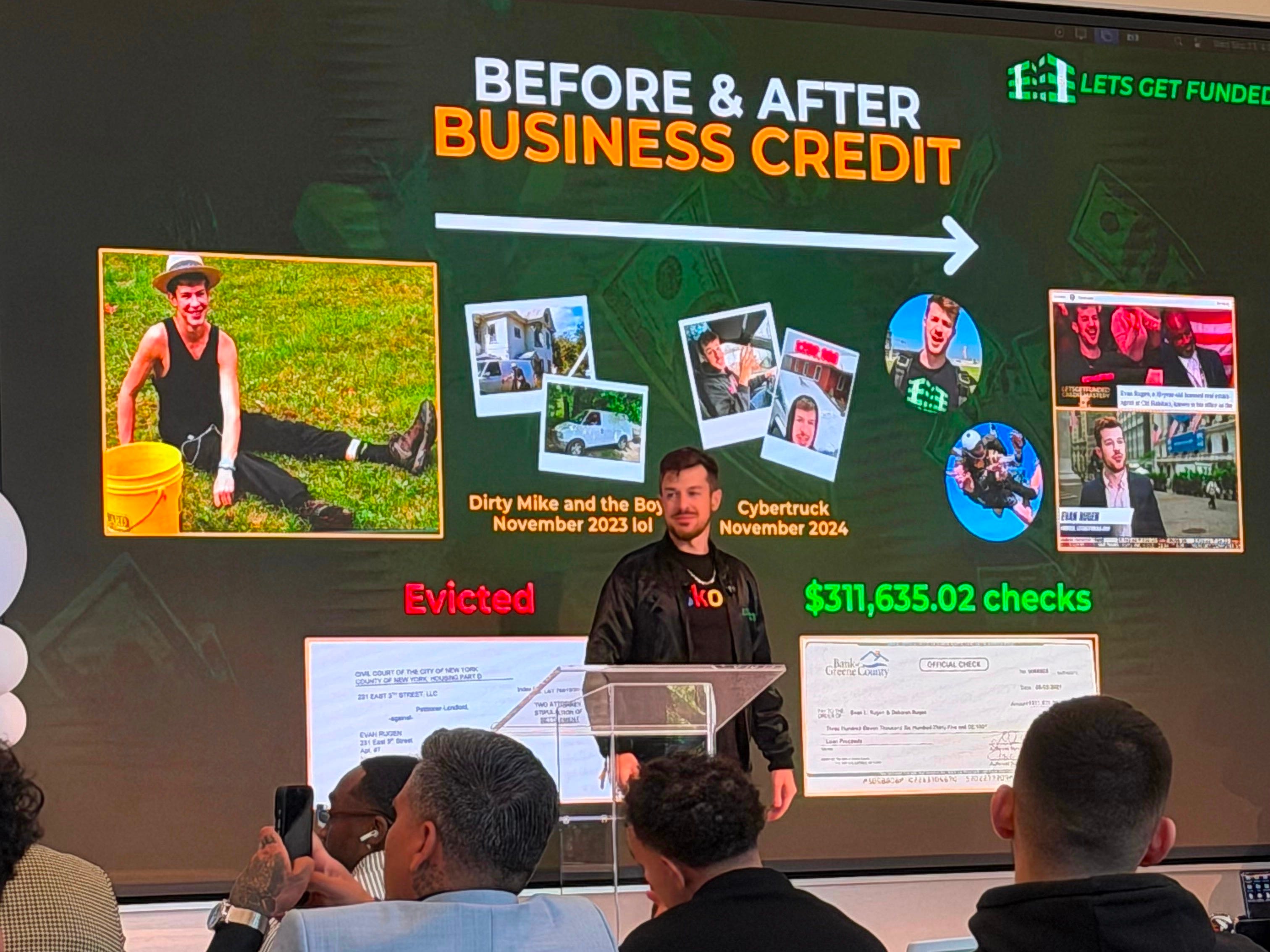
His starting point was the cheap leads pouring into his Instagram messages — the people he called “bottom of the barrel,” some still waiting for payday. The trick was to make those customers profitable without personally attending to them—and to make credit repair the beginning of the transaction, rather than the end. A new Instagram follower received a prerecorded voice note from Rugen, then an AI took over the conversation. His team had spent roughly 250 hours scripting it to sound human, he said. “AI is absolutely dynamite when you don’t know it’s AI, right?” The bot could follow up with a prospective credit-repair customer for six months before closing a $97 sale. He invited attendees to try it: DM @boweryboi a message that included “$97” in the text, and converse with his automated counterpart while he continued his presentation.
The small sale was worth pursuing because it could lead to months of payments — and more and more followers. Rugen said he spent roughly $70 to acquire a customer who would ultimately spend $600 to $700. SmartCredit and his paid Skool communities together brought his company about $250,000 a month in recurring revenue, he said. That predictable income gave him the confidence to keep buying ads — between $9,000 and $10,000 a day.
Inside the community, the selling could continue. He had a separate mentorship program as well, where for a fee, he was teaching entrepreneurs how they, too, could become versions of himself: their own ads, their own tireless chatbots, their own streams of subscription revenue. And, naturally, more customers feeding disputes into the same credit bureaus.
This was early days, Rugen said. Soon, it would be mainstream.

“We family now”
The very newest addition to the family, was one that fans of a certain era of hip-hop knew very well: Rick Ross, the rapper who had made a hit record, and a life philosophy, out of hustling. “I was excited to come here today and be in a room full of hustlers,” Ross told the crowd. “We all hustling.”
Coulter had recruited Ross to endorse SmartCredit, bringing the platform to his enormous social following (20 million Instagram followers and counting). He too would be promoting subscriptions. “Every conversation that I want to have, I want to find a way to incorporate smartcredit.com some way,” Ross said. Describing his approach to partnerships, he said a company might ask for two social-media posts a month. “We’re gonna have two posts by nine a.m. every day.”
He had plans for social posts, partnerships, and to get five people together for a weekly Zoom — “I call them Vroom calls” — and figure out how to accelerate. A good idea could come from anywhere, at any time.
“I have an open phone policy,” he said. “It’s never too late to text me. It’s never too late to fucking call me.” Vacations were fine, provided you brought your phone. “All that, ‘Put your phone down?’ No, fuck that. That’s like telling me to put the hustle down.”
Coulter urged the crowd to repost Ross. Ross offered to return the favor. “And when you make a post, tag me, tag him without a doubt. And don’t be surprised if I repost you. Like I say, we family now.”
Ross would be watching. “Because while you sleep, I be scrolling. I jump in your comments, put those fire flames, put those thumbs up, that’s what I’m gonna do, because I have a problem sleeping,” Ross said. “It is what it is.”
The credit bureaus were already struggling with the biggest flood of disputes they’d seen thus far. Now Ross was bringing the business to his 20 million followers—and promising to keep at it. Just another day in the life of the self-crowned boss.
Coulter had opened the conference by assuring the room that making more money meant helping more people. But for lenders, the crucial question is: Who are they helping?
Fraudsters can buy the same help as honest borrowers. Both put the credit repair industry’s machinery to work; both pay subscription fees; both claims acquire the same professional polish. At the conference, the inner gears were briefly visible: the influencers, the subscription companies, the outsourced workers, and the AI-maximized software were all cogs humming along efficiently in tune. But credit bureaus only see the output. Every dispute will look like a letter from one consumer, bearing one signature, asking for a fresh start.